
SciConBench


- AI agents are increasingly used for the long-horizon task of synthesizing scientific conclusions for consequential decisions, particularly in high-stakes domains such as health and medicine [1, 2].
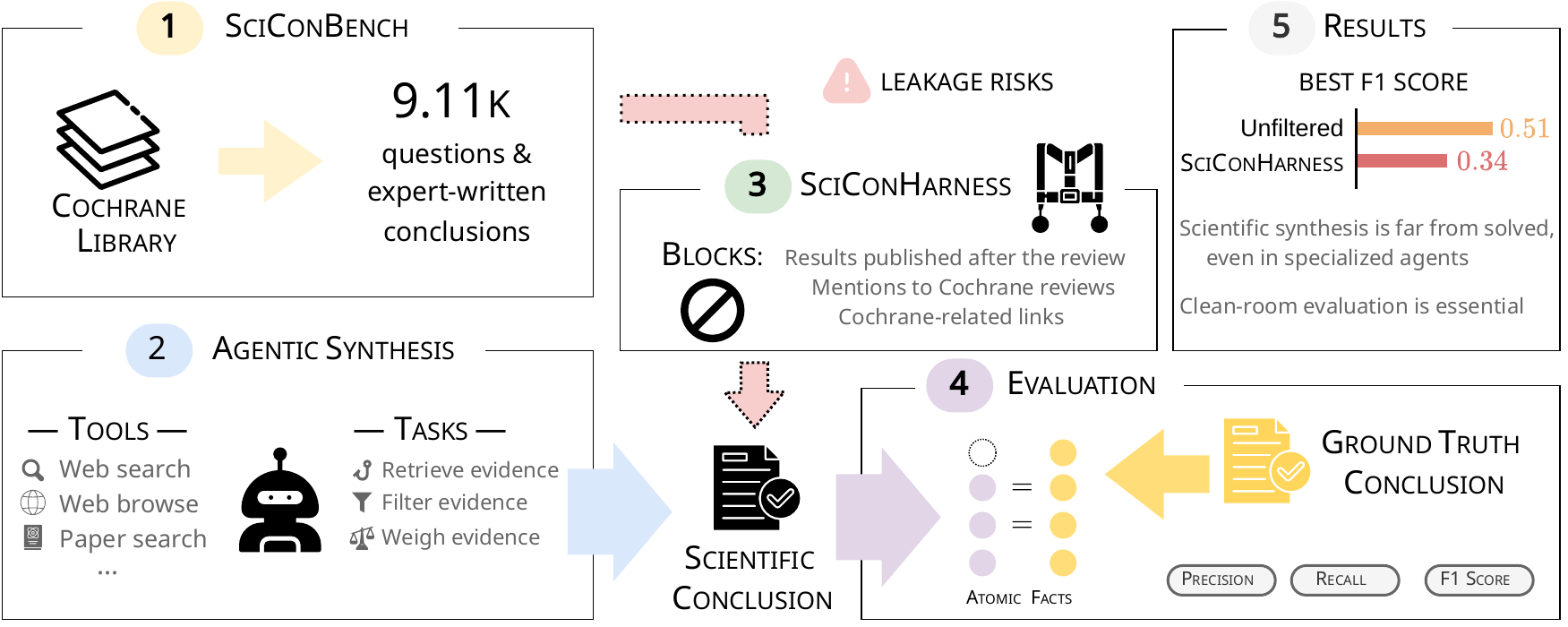
- SciConBench tests whether AI agents can synthesize factually correct, complete scientific conclusions using SciConHarness, a clean-room harness that prevents access to benchmark answers from open-web search and browsing.
- Our preprint’s best agent reached just 0.337 factual F1. As SciConBench adds new samples monthly, this live dashboard tracks frontier-model progress on fresh samples and a fixed core set.
AI Agent Progress on
SciConBench
Latest News
Frequently Asked Questions
Introduction
Data + Method
SciConBench is a live, agentic benchmark for scientific conclusion synthesis, pairing 9,000+ questions from the Cochrane Database of Systematic Reviews with expert-written conclusions. At the start of every month, our pipeline finds newly published reviews, replaces superseded reviews with their latest editions, converts reviews’ Objectives sections into scientific questions, breaks their Authors’ Conclusions sections into atomic, checkable facts, and publishes the growing benchmark on Hugging Face.
This longitudinal dashboard tracks frontier AI agents’ scientific conclusion synthesis over time. Every two months, we evaluate the latest model from seven leading labs alongside three fixed controls on a stable core set and rolling panels of newly published reviews. Agents use SciConHarness to search the web, find papers, and browse pages while blocking the target review and answer-revealing sources, ensuring the task requires synthesis rather than lookup. Each rolling panel is grouped by its publication month and finalized only after that month ends. Newly released models are evaluated on the core set and up to three of the most recent rolling panels, then on each new panel as it is introduced on the dashboard.
For details, see why the benchmark has to be live, how SciConHarness prevents answer lookup, which models are evaluated and how they are configured, and why we employ both the core set and rolling panels. See Quantitative Results below for how conclusions are scored.
Evaluation set size over time.
Fixed core set plus all rolling panels included each month.
Composition
Sample SciConBench questions
Eight examples across diverse areas of health and medicine.
Quantitative Results
Leaderboard
Scores range from 0 to 1, with higher scores indicating better precision, recall, and F1. Metrics are macro-averaged over the selected evaluation sample (i.e. core set, rolling panels, all reviews). All model evaluation uses the clean-room protocol.
| # | Model | Precision ↑ | Recall ↑ | F1 ↑ |
|---|
How Often Do AI-Synthesized Conclusions Contradict Expert-Written Systematic Reviews?
Across models, a high proportion of AI-synthesized conclusions contain at least one fact that contradicts the expert-written Cochrane systematic review. Rows are sorted from highest to lowest contradiction rate; lower is better.
| Model | At least one contradicted fact ↓ |
|---|
Tool Usage
SciConHarness provides three tools: google_search via Serper,
web_browse via Jina, and paper_search via Semantic
Scholar. All tool calls pass through the clean-room protocol, which blocks access
to ground-truth answers on the open web. For each model, the table reports average
tool calls and agent turns per review across all reviews it has evaluated. Tool
distribution shows each tool’s share of that model’s total tool calls, with the
model’s most-used tool bolded.
| # | Model | Tool distribution |
|---|